10 Best OTP Providers for Secure Authentication in 2026
What to look for in an OTP provider and who delivers the best value in 2026

Nam Hing Chau
Marketing Manager
How we evaluated these providers: Each provider was assessed specifically on OTP and verification use cases, not general SMS delivery. Our criteria include: fraud detection architecture (pre-send vs. reporting-layer), dedicated verify API (native vs. bolted on), conversion analytics (can you see cost-per-verified-user?), multi-channel fallback, compliance certifications, and onboarding speed. Providers without meaningful OTP-specific features were excluded from this list. For a broader comparison of SMS API providers across all messaging use cases, see our best SMS API providers guide.
One-Time Passwords (OTPs) are the most widely deployed form of multi-factor authentication, across fintech, healthcare, SaaS, and consumer apps to verify users at login, onboarding, transaction confirmation and any other sensitive actions.
Choosing the right OTP provider has never been more important than in 2026. With AI and cyber threats on the rise and businesses expanding globally, security and reliability are non-negotiable. Users expect rapid and seamless authentication, anywhere, anytime.
A strong OTP provider ensures not only that the codes are delivered fast but also that security is top-notch, protecting your platform from fraud and ensuring data privacy. But not all OTP providers are built the same way.
Most SMS APIs can send a verification code. What separates a true OTP provider from a generic messaging platform is everything that happens around the send: fraud detection before delivery, routing optimization during delivery, and conversion visibility after it.
This guide compares ten OTP providers specifically for authentication and verification use cases. If your primary need is general-purpose SMS messaging beyond OTP, the more relevant comparison is our best SMS API providers guide.
What is an OTP Provider and How is it Different From a General SMS API?
An OTP provider manages the infrastructure required to verify users through one-time passwords across SMS, voice, WhatsApp, email, and other authentication channels.
Unlike a generic SMS API, an OTP platform doesn't just send messages. It manages the full verification lifecycle: code generation, delivery routing, fraud risk assessment, fallback logic when SMS fails, and the analytics that tell you whether users are actually completing verification.
That distinction becomes increasingly important at scale, where authentication reliability, fraud exposure, carrier filtering, and verification conversion rates directly impact user onboarding and operational cost.
How to Choose the Right OTP Provider?
The best provider for your team depends on where your users are located, how sensitive your flows are to fraud, and how much operational visibility you need into authentication success rates.
Here are the criteria that matter most when evaluating OTP infrastructure in 2026:
Fraud prevention architecture
This is the criterion that matters most for OTP-specific use cases. Look for providers where fraud detection is built into the routing layer- blocking suspicious requests before the message is sent and cost is incurred rather than surfacing anomalies in billing reports after the fact.
For high-volume authentication systems, the architectural difference can mean thousands of dollars in avoided fraud exposure during a single attack.
Speed of delivery
Time is of the essence in authentication. A code that arrives 30 seconds late creates friction and failed logins. Choose a provider with optimized carrier routing and minimal latency, particularly in the regions where your users are concentrated.
Route quality and global reach
Your user base isn't limited to one region and your OTP provider shouldn't be either. Look for a provider with direct carrier connections and not just aggregator routes in the countries you serve. Aggregated routing adds latency and reduces reliability in markets where direct routes matter most.
This matters especially in markets where SMS infrastructure is inconsistent or filtering is aggressive, including parts of India, LATAM, Southeast Asia, and Africa.
Global reach alone is not enough. Route quality is what determines whether users actually receive codes on time.
Multi-channel fallback
SMS delivery is not universally reliable.
A provider that supports voice OTP in addition to SMS verification, as well as channels like email, voice, WhatsApp and Telegram, ensures verification can complete even when SMS delivery fails, which matters significantly in markets with aggressive carrier filtering.
Fallback infrastructure is increasingly important for international applications where SMS reliability varies significantly by geography.
Conversion rate
Delivery rate alone isn't enough. The metric that actually matters is verification conversion rate: the percentage of users who successfully complete authentication after an OTP is sent.
Look for a provider that shows you OTP conversion rate, that is the proportion of codes sent that result in successful verification broken down by country and channel. This is the metric that tells you whether your authentication flow is actually working, not just whether messages are being sent.
Pricing transparency
OTP pricing is often more complicated than advertised.
Look for a provider with clear, predictable pricing that scales with you. Whether pay-as-you-go or subscription-based, the effective cost per successfully verified user, not just per message sent, should be visible before you commit. Hidden carrier surcharges and opaque invoices are a sign of a model that doesn't favor the customer at scale.
Security and compliance
Look for providers with robust encryption standards and compliance certifications relevant to your industry and region such as SOC 2 or GDPR. A secure OTP provider treats compliance as a baseline, not an add-on.
For regulated industries like fintech and healthcare, compliance maturity should be treated as a baseline requirement. A secure OTP provider should offer more than just codes, it should protect your business from threats.
Responsive support
When a delivery issue blocks your authentication flow, response time matters. The best OTP providers typically offer direct technical guidance rather than routing teams through generic support queues.
Look for a provider that offers direct access to a technical team and not just a ticket queue, especially during integration and in the early stages of going live.
One decision that comes before provider selection is whether to use a provider at all. If your team is weighing the option of building your own OTP system in-house, the trade-offs around engineering cost, fraud exposure, and time to launch are worth examining first. Our build vs. buy guide for OTP verification covers them in detail.
The 10 Best OTP Providers in 2026
Not all OTP providers are built for the same type of customer. Some optimize for enterprise-scale global delivery, while others focus on fraud prevention, conversion optimization, developer experience, or pricing transparency.
1.Prelude

Prelude.so is built specifically for OTP and authentication use cases. Its entire stack from pricing, API and dashboard to fraud detection, and routing is designed around verification outcomes rather than general messaging delivery. Its positioning is especially strong for consumer applications dealing with SMS pumping fraud, onboarding abuse, or inconsistent international delivery performance.
Strengths:
Pre-send fraud detection. The Watch API scores every verification request for risk signals before routing, blocking suspected SMS pumping before the message is sent and cost is incurred
No markup on carrier costs. Prelude passes through what telecoms charge without a margin. At scale, this is a meaningful cost difference versus providers that add a per-message markup
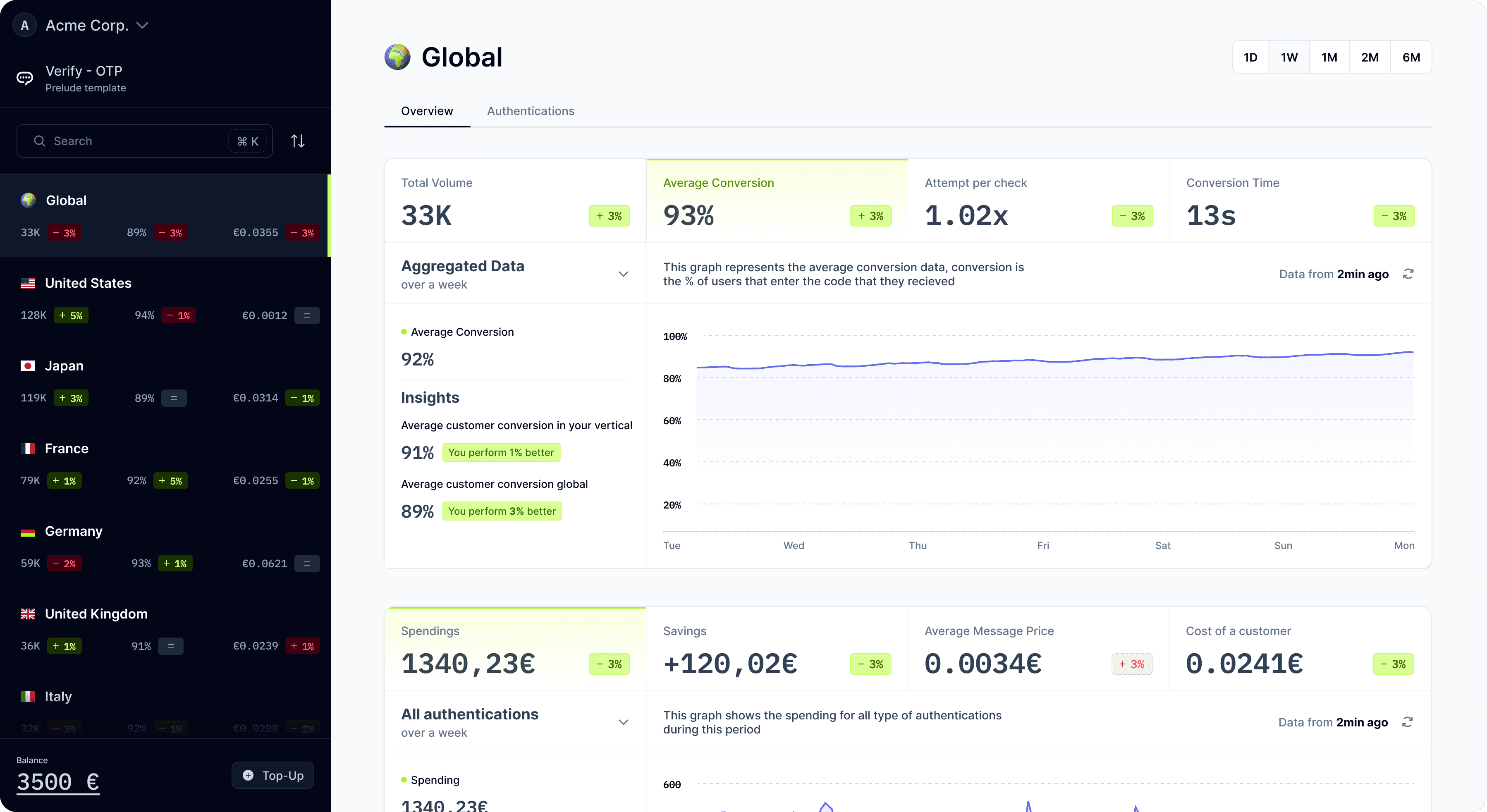
Conversion analytics. The dashboard shows delivery rate, OTP conversion rate (sent → verified), and cost-per-verified-user broken down by country and channel
Native multi-channel routing. SMS, voice, WhatsApp, Telegram, Viber, RCS, and Silent Network Authentication (SNA) are all routable from a single API call with automatic fallback
Direct Slack support with the engineering team on all plans
SOC 2 Type II and ISO/IEC 27001 certified
Covers Web, native mobile (iOS & Android), and cross-platform frameworks like React Native and Flutter SDKs, enabling SMS APIs for Flutter apps at scale.
Weaknesses
Smaller ecosystem than Twilio or Vonage
More verification-focused than broad CPaaS platforms
Ideal for:
Startups, fintechs, and growth-stage SaaS teams whose primary use case is user verification and authentication that need a secure, fraud-protected OTP system.
Verdict:
Prelude is one of the few providers positioning verification as an optimization problem rather than a delivery problem. The platform focuses heavily on fraud prevention, route intelligence, and improving successful verification rates across international markets. Teams dealing with SMS pumping, onboarding abuse, or inconsistent delivery performance will likely find more operational visibility here than with traditional messaging APIs.
2.Twilio
Twilio Verify is one of the most widely adopted authentication APIs on the market. Its biggest advantages are maturity, global scale, and developer familiarity. While newer OTP-focused providers have become more specialized around fraud prevention and conversion analytics, Twilio still offers one of the most stable enterprise-grade verification platforms available.
Strengths:
High scalability and carrier coverage across 200+ countries
Well-documented Verify API with SDKs across every major language
Real-time analytics and reporting
Secure infrastructure with robust encryption
Broad multi-channel support - SMS, voice, email, WhatsApp, push, and Silent Network Auth
Weaknesses:
Expensive at high verification volume
Pricing complexity that makes cost forecasting difficult for smaller teams
Fraud tooling less specialized than newer verification-focused providers
Ideal for:
Global enterprise teams that need mature infrastructure, broad ecosystem support, and the widest possible channel coverage.
Verdict:
Twilio remains the default choice for many engineering organizations because of its maturity, documentation, and ecosystem breadth. Its Verify product significantly reduces implementation overhead for authentication flows, though costs can rise quickly at scale and fraud tooling requires more configuration than purpose-built OTP platforms.
3.Bird (previously MessageBird)

Bird offers a comprehensive OTP service with seamless delivery across SMS, email, and voice channels. It’s known for its reliable global coverage and high delivery success rates.
Strengths:
Wide global reach with presence in over 150 countries
Strong multichannel OTP delivery
Highly secure, with end-to-end encryption
Customizable solutions for businesses of all sizes
Unified API across channels reduces integration complexity
Weaknesses:
Pricing not self-serve; quote-based for most plans
Verification-specific features less developed than dedicated OTP platforms
Ideal for:
Businesses looking for a reliable, global OTP provider with high delivery success rates or teams that want OTP alongside CRM and customer messaging from a single vendor.
Verdict:
MessageBird is strongest for businesses operating internationally across multiple communication channels. Its routing network and omnichannel capabilities make it particularly useful for teams prioritizing global authentication coverage.
4. Plivo
Plivo offers a flexible, API-driven OTP service with an emphasis on speed and security. Known for its developer-friendly interface, Plivo is ideal for businesses looking to build custom OTP solutions with minimal complexity.
Strengths:
Flexible API for custom OTP solutions
Reliable delivery for standard SMS OTP flows
Clean developer documentation and SDKs across major languages
Fraud Shield included at no extra charge
Transparent, pay-as-you-go pricing
Weaknesses:
Less sophisticated verification analytics
RCS and email OTP channels not yet available
Ideal for:
Developers and businesses looking for a customizable and cost-effective OTP service.
Verdict:
Plivo is a practical option for teams looking for reliable OTP infrastructure without the pricing complexity or operational overhead of larger enterprise providers.
5. Sinch
Sinch is a telecom-focused communications platform with deep carrier relationships and large-scale messaging infrastructure. Its authentication capabilities are strongest for enterprises that prioritize global delivery performance, direct routing relationships, and telecom-grade reliability over lightweight developer tooling. It's trusted by large financial institutions and enterprises with strict regulatory requirements.
Strengths:
Highly secure with strong encryption and fraud prevention
600+ direct operator connections
Developer-friendly with easy API integration
Flashcall and seamless/data authentication- frictionless verification methods not widely available at production scale elsewhere
Dedicated verification API (not just raw SMS)
Weaknesses
Complex enterprise onboarding
Less flexible for smaller teams
Ideal for:
Large enterprises, fintechs, and healthcare platforms where carrier-level SLAs and compliance tooling are non-negotiable requirements, or enterprises requiring the deepest carrier network and direct US operator integrations..
Verdict:
Sinch is best suited for large-scale authentication systems where carrier connectivity and global infrastructure matter more than implementation simplicity. For teams where UX friction during authentication directly impacts conversion, flashcall and seamless authentication are worth evaluating seriously; no other provider offers them at comparable scale.
6.Infobip
Infobip is a major player in the OTP space, offering comprehensive authentication solutions with exceptional global reach and multichannel delivery options.
Strengths:
Global infrastructure with high delivery reliability at large scale
Full multichannel OTP support from a single platform
Infobip Signals- automated SMS pumping detection and blocking; only charges for legitimate messages
Developer-friendly API
Weaknesses:
Longer onboarding cycles
Less startup-friendly implementation experience
Ideal for:
Global and large-scale businesses needing a multichannel OTP solution.
Verdict:
Infobip is the most feature-complete enterprise OTP platform on this list but it's designed for organizations with the procurement process, budget, and engineering capacity to match. Smaller teams will find the complexity and engagement model a poor fit.
7.Vonage (Part of Ericsson)
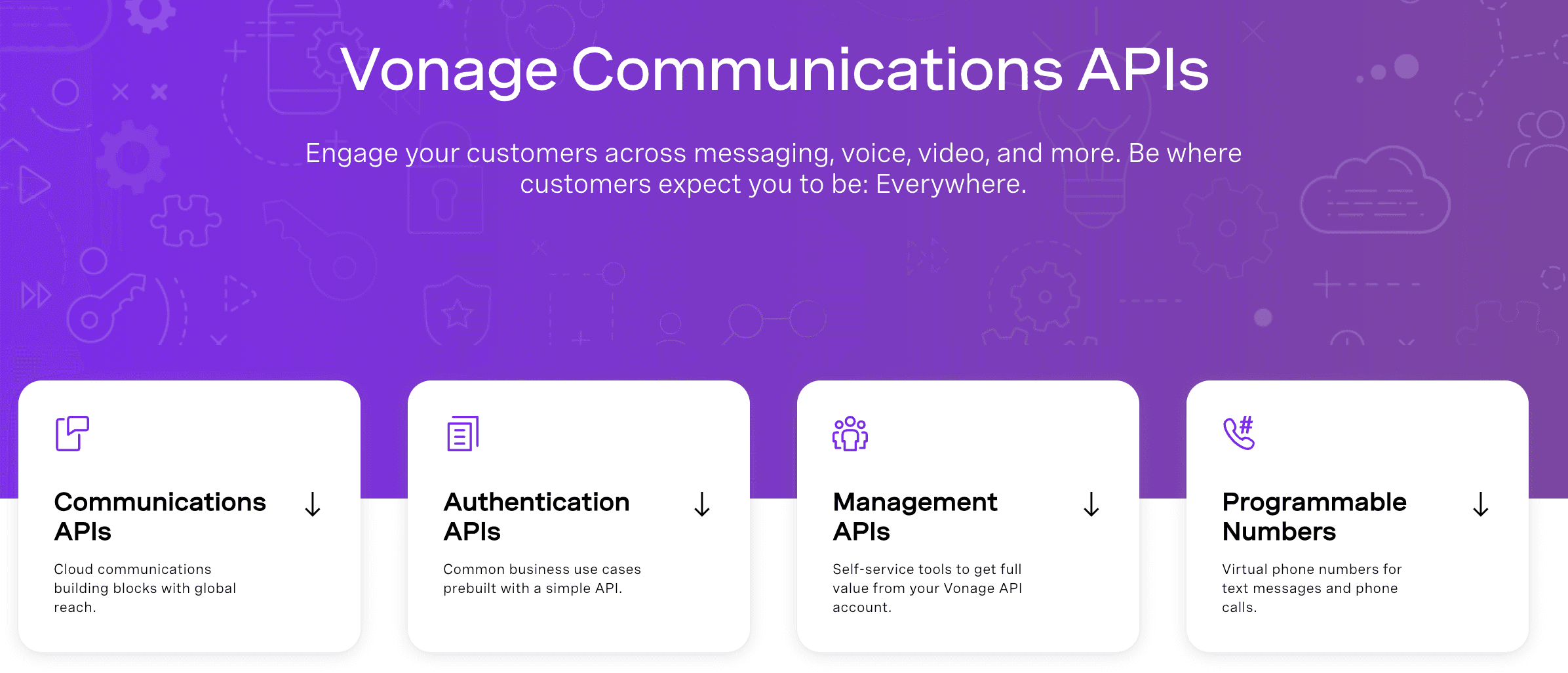
Vonage Verify is a mature authentication platform designed for businesses that need flexible multi-channel verification workflows at scale. The company combines global messaging infrastructure with configurable authentication flows across SMS and voice channels.
Strengths:
Global network for high availability
Reports API consolidating delivery, billing, and verification event data
Strong focus on security with encryption
Flexible pricing options for businesses of all sizes
Identity Insights API (GA): real-time phone intelligence including SIM swap status, carrier data, and Subscriber Match
Weaknesses:
Pricing transparency can be limited
More enterprise-oriented sales process
Ideal for:
Developers and businesses looking for a scalable, flexible OTP service and who need sophisticated multi-channel fallback workflows with intelligent channel selection.
Verdict:
Vonage Verify has shipped meaningfully in the past 12 months. Silent Authentication, the Identity Insights API, and the US network API make it a credible fraud-aware platform, not just a delivery layer. It’s also a strong option for teams that need reliable authentication infrastructure with flexible fallback support across SMS and voice channels.
8.Telesign
Telesign approaches authentication primarily through the lens of identity intelligence and fraud prevention. In addition to OTP delivery, the platform provides phone reputation scoring and risk analysis capabilities designed to help companies detect suspicious verification attempts before authentication is completed.
Strengths:
Verify Plus: Conduct risk-based assessments to detect fraudulent threats before sending an OTP
Single API across SMS, voice, push, email, WhatsApp, Viber, and RCS with configurable fallback timing per channel
Coverage across 230+ countries and territories
Weaknesses:
Verify Plus priced as an add-on (fraud protection isn't included in the base tier)
Multi-channel routing flexibility less developed than Vonage or Infobip
Ideal for:
Platforms where fraud prevention is a primary concern alongside OTP delivery, particularly consumer apps with high anonymous signup volumes, marketplaces, or any product where IRSF or promotion abuse is a known risk.
Verdict:
If your primary concern is identity intelligence- knowing whether a phone number is legitimate before sending anything- Telesign's dataset and ML models are the most mature on this list. It’s especially relevant for high-risk industries where fraud scoring and phone reputation analysis are core parts of authentication workflows. The trade-off is that Verify Plus is an add-on, so fraud protection has an additional cost that other providers include by default.
9.Auth0 (Okta)
Auth0 approaches OTP verification from the identity layer rather than the telecom layer. Instead of acting primarily as a messaging provider, Auth0 provides authentication infrastructure that includes passwordless login, MFA, and OTP-based verification flows as part of a broader identity management platform.
Strengths:
Full identity management (login, MFA, SSO, user management, social login) in one platform
Strong compliance posture — SOC 2, HIPAA, GDPR
Passwordless authentication flows
Strong developer tooling
Weaknesses:
Not a standalone OTP API- can't be called directly for verification outside Auth0's login system
Expensive for high-volume OTP-only use cases; priced as identity platform, not per-verification
Ideal for:
Teams that need a complete identity platform with built-in MFA rather than a standalone OTP delivery API — particularly B2C products where login, social auth, and phone verification are all needed from one system.
Verdict:
Auth0 is strongest for teams solving authentication holistically rather than optimizing OTP delivery infrastructure specifically. It’s particularly attractive for SaaS platforms that want identity management and verification in the same stack.
10. Firebase Authentication
Firebase Authentication is Google’s developer-focused authentication platform designed for rapid implementation of login and identity workflows. OTP support is included as part of a broader authentication toolkit that prioritizes developer simplicity and fast product iteration.
Strengths:
Free tier covers 10,000 verifications/month on the Spark plan
App Check for additional abuse protection alongside reCAPTCHA and SafetyNet
Strong mobile developer experience
Weaknesses:
Fewer advanced fraud prevention capabilities
Less infrastructure visibility
Ideal for:
Mobile-first teams already on Firebase who need straightforward phone verification with minimal setup and want to start without a provider cost.
Verdict:
Firebase Authentication is the right choice for a specific profile: early-stage mobile apps already on Google infrastructure, low verification volumes, and no high-fraud exposure. Once volumes scale or fraud becomes a concern, the lack of conversion analytics and fraud tooling depth becomes a meaningful limitation.
Which OTP Provider is Right for Your Use Case?
The best OTP provider depends heavily on the type of authentication system you're looking for. Some platforms are optimized for fraud-resistant verification at scale, while others prioritize developer simplicity, enterprise identity management, or international routing performance.
Here’s how the leading providers compare by use case.
Use Case | Recommended Provider | Why |
Fraud-resistant OTP verification | Prelude | Pre-send fraud detection, routing optimization, and verification analytics |
Enterprise authentication infrastructure | Twilio Verify | Mature global infrastructure and ecosystem scale |
Identity management + OTP | Auth0 | Strong MFA and authentication workflow tooling |
Fastest implementation for startups | Firebase Authentication | Developer-friendly setup and mobile integration |
International authentication coverage | Infobip | Strong direct carrier relationships globally |
Omnichannel verification | MessageBird | SMS, WhatsApp, voice, and messaging app fallback |
Telecom-grade reliability | Sinch | Deep carrier infrastructure and enterprise delivery |
Identity intelligence and risk scoring | Telesign | Fraud scoring and phone reputation tooling |
Cost-conscious SMS verification | Plivo | Simple APIs, no verification fee, fraud protection included |
Voice-heavy or frictionless authentication | Vonage Verify | Silent Authentication, voice fallback and multi-channel workflows |
Conclusion
Choosing the right OTP provider is a crucial decision for any business in 2026. With the increasing demand for speed, security, and scalability, it’s essential to select a provider that not only delivers fast and reliable OTPs but also offers strong fraud protection and global reach.
Whether you’re a small startup or an enterprise, ensuring your users’ security while enabling smooth authentication experiences is key to maintaining trust and growing your business.
FAQs
Which OTP provider has the best fraud protection?
Several providers now offer meaningful pre-send fraud detection, not just post-hoc reporting. Prelude's Watch API, Telesign's Verify Plus, Twilio's Fraud Guard, Plivo's Fraud Shield, Vonage's Fraud Defender, and Infobip Signals all claim to detect and block suspicious traffic before messages are sent.
The key differentiators are: whether the fraud detection is included at no extra cost (Plivo, Prelude) or priced as an add-on (Telesign Verify Plus) as well as the depth of the underlying identity dataset used for risk scoring.
Which OTP provider is easiest to integrate?
Prelude, Plivo, and Firebase are consistently rated highest for onboarding speed. All three offer public documentation, self-serve signup, and test environments without a sales call. Firebase is fastest for mobile-native teams. Sinch and Infobip require vendor engagement before you can start.
Should I use a dedicated OTP provider or build my own?
For most teams, a dedicated provider delivers better results at lower total cost than building in-house. The engineering complexity of carrier relationships, routing logic, fraud detection, and compliance maintenance compounds quickly. See our build vs. buy guide for OTP verification for a detailed breakdown of when building makes sense.
What is the cheapest OTP provider?
The cheapest OTP provider depends on your usage and location. Providers like Prelude offer affordable pricing with competitive rates, especially for small to medium-sized businesses. Always check the pricing model that best fits your business needs.
Can you get free OTP services?
While some OTP providers offer free trials, ongoing OTP services typically aren’t free. Free services often come with limited features or lower delivery success rates. It’s important to weigh cost vs. security when choosing a provider.
What is better: email OTP or SMS OTP?
Both have their pros and cons. SMS OTP is generally faster and more widely accessible, while email OTP can be more secure but may take longer to reach. Consider your audience and choose the method that best suits their needs and your security standards.
What security features should you look for in an OTP provider?
Look for providers with strong encryption, fraud protection, and compliance certifications (like SOC 2 or GDPR). A good provider should also offer risk scoring and real-time fraud detection to protect both your users and your business from security threats or monetary fraud like SMS pumping.
I'm currently on Twilio. Which provider should I switch to?
That depends. If pricing complexity is the main issue, Prelude's no-markup model or Plivo's no-verification-fee structure are the most direct fixes. If fraud protection is the concern, Telesign or Prelude. If you need to stay on a Twilio-comparable platform with similar breadth, Vonage Verify is the closest feature-equivalent at lower per-OTP cost for most volume tiers. For a full comparison, see our Twilio alternatives guide.
What's Next?
If you're ready to evaluate specific providers, the comparison above covers the OTP-specific criteria that matter most. For context on how OTP fits into your broader authentication architecture, the SMS OTP guide covers implementation, security trade-offs, and channel selection in detail.
If you're also evaluating general-purpose SMS APIs beyond verification, see our best SMS API providers comparison. For transactional-specific use-cases, see our transactional providers comparison.
How we evaluated these providers: Each provider was assessed specifically on OTP and verification use cases, not general SMS delivery. Our criteria include: fraud detection architecture (pre-send vs. reporting-layer), dedicated verify API (native vs. bolted on), conversion analytics (can you see cost-per-verified-user?), multi-channel fallback, compliance certifications, and onboarding speed. Providers without meaningful OTP-specific features were excluded from this list. For a broader comparison of SMS API providers across all messaging use cases, see our best SMS API providers guide.
One-Time Passwords (OTPs) are the most widely deployed form of multi-factor authentication, across fintech, healthcare, SaaS, and consumer apps to verify users at login, onboarding, transaction confirmation and any other sensitive actions.
Choosing the right OTP provider has never been more important than in 2026. With AI and cyber threats on the rise and businesses expanding globally, security and reliability are non-negotiable. Users expect rapid and seamless authentication, anywhere, anytime.
A strong OTP provider ensures not only that the codes are delivered fast but also that security is top-notch, protecting your platform from fraud and ensuring data privacy. But not all OTP providers are built the same way.
Most SMS APIs can send a verification code. What separates a true OTP provider from a generic messaging platform is everything that happens around the send: fraud detection before delivery, routing optimization during delivery, and conversion visibility after it.
This guide compares ten OTP providers specifically for authentication and verification use cases. If your primary need is general-purpose SMS messaging beyond OTP, the more relevant comparison is our best SMS API providers guide.
What is an OTP Provider and How is it Different From a General SMS API?
An OTP provider manages the infrastructure required to verify users through one-time passwords across SMS, voice, WhatsApp, email, and other authentication channels.
Unlike a generic SMS API, an OTP platform doesn't just send messages. It manages the full verification lifecycle: code generation, delivery routing, fraud risk assessment, fallback logic when SMS fails, and the analytics that tell you whether users are actually completing verification.
That distinction becomes increasingly important at scale, where authentication reliability, fraud exposure, carrier filtering, and verification conversion rates directly impact user onboarding and operational cost.
How to Choose the Right OTP Provider?
The best provider for your team depends on where your users are located, how sensitive your flows are to fraud, and how much operational visibility you need into authentication success rates.
Here are the criteria that matter most when evaluating OTP infrastructure in 2026:
Fraud prevention architecture
This is the criterion that matters most for OTP-specific use cases. Look for providers where fraud detection is built into the routing layer- blocking suspicious requests before the message is sent and cost is incurred rather than surfacing anomalies in billing reports after the fact.
For high-volume authentication systems, the architectural difference can mean thousands of dollars in avoided fraud exposure during a single attack.
Speed of delivery
Time is of the essence in authentication. A code that arrives 30 seconds late creates friction and failed logins. Choose a provider with optimized carrier routing and minimal latency, particularly in the regions where your users are concentrated.
Route quality and global reach
Your user base isn't limited to one region and your OTP provider shouldn't be either. Look for a provider with direct carrier connections and not just aggregator routes in the countries you serve. Aggregated routing adds latency and reduces reliability in markets where direct routes matter most.
This matters especially in markets where SMS infrastructure is inconsistent or filtering is aggressive, including parts of India, LATAM, Southeast Asia, and Africa.
Global reach alone is not enough. Route quality is what determines whether users actually receive codes on time.
Multi-channel fallback
SMS delivery is not universally reliable.
A provider that supports voice OTP in addition to SMS verification, as well as channels like email, voice, WhatsApp and Telegram, ensures verification can complete even when SMS delivery fails, which matters significantly in markets with aggressive carrier filtering.
Fallback infrastructure is increasingly important for international applications where SMS reliability varies significantly by geography.
Conversion rate
Delivery rate alone isn't enough. The metric that actually matters is verification conversion rate: the percentage of users who successfully complete authentication after an OTP is sent.
Look for a provider that shows you OTP conversion rate, that is the proportion of codes sent that result in successful verification broken down by country and channel. This is the metric that tells you whether your authentication flow is actually working, not just whether messages are being sent.
Pricing transparency
OTP pricing is often more complicated than advertised.
Look for a provider with clear, predictable pricing that scales with you. Whether pay-as-you-go or subscription-based, the effective cost per successfully verified user, not just per message sent, should be visible before you commit. Hidden carrier surcharges and opaque invoices are a sign of a model that doesn't favor the customer at scale.
Security and compliance
Look for providers with robust encryption standards and compliance certifications relevant to your industry and region such as SOC 2 or GDPR. A secure OTP provider treats compliance as a baseline, not an add-on.
For regulated industries like fintech and healthcare, compliance maturity should be treated as a baseline requirement. A secure OTP provider should offer more than just codes, it should protect your business from threats.
Responsive support
When a delivery issue blocks your authentication flow, response time matters. The best OTP providers typically offer direct technical guidance rather than routing teams through generic support queues.
Look for a provider that offers direct access to a technical team and not just a ticket queue, especially during integration and in the early stages of going live.
One decision that comes before provider selection is whether to use a provider at all. If your team is weighing the option of building your own OTP system in-house, the trade-offs around engineering cost, fraud exposure, and time to launch are worth examining first. Our build vs. buy guide for OTP verification covers them in detail.
The 10 Best OTP Providers in 2026
Not all OTP providers are built for the same type of customer. Some optimize for enterprise-scale global delivery, while others focus on fraud prevention, conversion optimization, developer experience, or pricing transparency.
1.Prelude
Prelude.so is built specifically for OTP and authentication use cases. Its entire stack from pricing, API and dashboard to fraud detection, and routing is designed around verification outcomes rather than general messaging delivery. Its positioning is especially strong for consumer applications dealing with SMS pumping fraud, onboarding abuse, or inconsistent international delivery performance.
Strengths:
Pre-send fraud detection. The Watch API scores every verification request for risk signals before routing, blocking suspected SMS pumping before the message is sent and cost is incurred
No markup on carrier costs. Prelude passes through what telecoms charge without a margin. At scale, this is a meaningful cost difference versus providers that add a per-message markup
Conversion analytics. The dashboard shows delivery rate, OTP conversion rate (sent → verified), and cost-per-verified-user broken down by country and channel
Native multi-channel routing. SMS, voice, WhatsApp, Telegram, Viber, RCS, and Silent Network Authentication (SNA) are all routable from a single API call with automatic fallback
Direct Slack support with the engineering team on all plans
SOC 2 Type II and ISO/IEC 27001 certified
Covers Web, native mobile (iOS & Android), and cross-platform frameworks like React Native and Flutter SDKs, enabling SMS APIs for Flutter apps at scale.
Weaknesses
Smaller ecosystem than Twilio or Vonage
More verification-focused than broad CPaaS platforms
Ideal for:
Startups, fintechs, and growth-stage SaaS teams whose primary use case is user verification and authentication that need a secure, fraud-protected OTP system.
Verdict:
Prelude is one of the few providers positioning verification as an optimization problem rather than a delivery problem. The platform focuses heavily on fraud prevention, route intelligence, and improving successful verification rates across international markets. Teams dealing with SMS pumping, onboarding abuse, or inconsistent delivery performance will likely find more operational visibility here than with traditional messaging APIs.
2.Twilio
Twilio Verify is one of the most widely adopted authentication APIs on the market. Its biggest advantages are maturity, global scale, and developer familiarity. While newer OTP-focused providers have become more specialized around fraud prevention and conversion analytics, Twilio still offers one of the most stable enterprise-grade verification platforms available.
Strengths:
High scalability and carrier coverage across 200+ countries
Well-documented Verify API with SDKs across every major language
Real-time analytics and reporting
Secure infrastructure with robust encryption
Broad multi-channel support - SMS, voice, email, WhatsApp, push, and Silent Network Auth
Weaknesses:
Expensive at high verification volume
Pricing complexity that makes cost forecasting difficult for smaller teams
Fraud tooling less specialized than newer verification-focused providers
Ideal for:
Global enterprise teams that need mature infrastructure, broad ecosystem support, and the widest possible channel coverage.
Verdict:
Twilio remains the default choice for many engineering organizations because of its maturity, documentation, and ecosystem breadth. Its Verify product significantly reduces implementation overhead for authentication flows, though costs can rise quickly at scale and fraud tooling requires more configuration than purpose-built OTP platforms.
3.Bird (previously MessageBird)
Bird offers a comprehensive OTP service with seamless delivery across SMS, email, and voice channels. It’s known for its reliable global coverage and high delivery success rates.
Strengths:
Wide global reach with presence in over 150 countries
Strong multichannel OTP delivery
Highly secure, with end-to-end encryption
Customizable solutions for businesses of all sizes
Unified API across channels reduces integration complexity
Weaknesses:
Pricing not self-serve; quote-based for most plans
Verification-specific features less developed than dedicated OTP platforms
Ideal for:
Businesses looking for a reliable, global OTP provider with high delivery success rates or teams that want OTP alongside CRM and customer messaging from a single vendor.
Verdict:
MessageBird is strongest for businesses operating internationally across multiple communication channels. Its routing network and omnichannel capabilities make it particularly useful for teams prioritizing global authentication coverage.
4. Plivo
Plivo offers a flexible, API-driven OTP service with an emphasis on speed and security. Known for its developer-friendly interface, Plivo is ideal for businesses looking to build custom OTP solutions with minimal complexity.
Strengths:
Flexible API for custom OTP solutions
Reliable delivery for standard SMS OTP flows
Clean developer documentation and SDKs across major languages
Fraud Shield included at no extra charge
Transparent, pay-as-you-go pricing
Weaknesses:
Less sophisticated verification analytics
RCS and email OTP channels not yet available
Ideal for:
Developers and businesses looking for a customizable and cost-effective OTP service.
Verdict:
Plivo is a practical option for teams looking for reliable OTP infrastructure without the pricing complexity or operational overhead of larger enterprise providers.
5. Sinch
Sinch is a telecom-focused communications platform with deep carrier relationships and large-scale messaging infrastructure. Its authentication capabilities are strongest for enterprises that prioritize global delivery performance, direct routing relationships, and telecom-grade reliability over lightweight developer tooling. It's trusted by large financial institutions and enterprises with strict regulatory requirements.
Strengths:
Highly secure with strong encryption and fraud prevention
600+ direct operator connections
Developer-friendly with easy API integration
Flashcall and seamless/data authentication- frictionless verification methods not widely available at production scale elsewhere
Dedicated verification API (not just raw SMS)
Weaknesses
Complex enterprise onboarding
Less flexible for smaller teams
Ideal for:
Large enterprises, fintechs, and healthcare platforms where carrier-level SLAs and compliance tooling are non-negotiable requirements, or enterprises requiring the deepest carrier network and direct US operator integrations..
Verdict:
Sinch is best suited for large-scale authentication systems where carrier connectivity and global infrastructure matter more than implementation simplicity. For teams where UX friction during authentication directly impacts conversion, flashcall and seamless authentication are worth evaluating seriously; no other provider offers them at comparable scale.
6.Infobip
Infobip is a major player in the OTP space, offering comprehensive authentication solutions with exceptional global reach and multichannel delivery options.
Strengths:
Global infrastructure with high delivery reliability at large scale
Full multichannel OTP support from a single platform
Infobip Signals- automated SMS pumping detection and blocking; only charges for legitimate messages
Developer-friendly API
Weaknesses:
Longer onboarding cycles
Less startup-friendly implementation experience
Ideal for:
Global and large-scale businesses needing a multichannel OTP solution.
Verdict:
Infobip is the most feature-complete enterprise OTP platform on this list but it's designed for organizations with the procurement process, budget, and engineering capacity to match. Smaller teams will find the complexity and engagement model a poor fit.
7.Vonage (Part of Ericsson)
Vonage Verify is a mature authentication platform designed for businesses that need flexible multi-channel verification workflows at scale. The company combines global messaging infrastructure with configurable authentication flows across SMS and voice channels.
Strengths:
Global network for high availability
Reports API consolidating delivery, billing, and verification event data
Strong focus on security with encryption
Flexible pricing options for businesses of all sizes
Identity Insights API (GA): real-time phone intelligence including SIM swap status, carrier data, and Subscriber Match
Weaknesses:
Pricing transparency can be limited
More enterprise-oriented sales process
Ideal for:
Developers and businesses looking for a scalable, flexible OTP service and who need sophisticated multi-channel fallback workflows with intelligent channel selection.
Verdict:
Vonage Verify has shipped meaningfully in the past 12 months. Silent Authentication, the Identity Insights API, and the US network API make it a credible fraud-aware platform, not just a delivery layer. It’s also a strong option for teams that need reliable authentication infrastructure with flexible fallback support across SMS and voice channels.
8.Telesign
Telesign approaches authentication primarily through the lens of identity intelligence and fraud prevention. In addition to OTP delivery, the platform provides phone reputation scoring and risk analysis capabilities designed to help companies detect suspicious verification attempts before authentication is completed.
Strengths:
Verify Plus: Conduct risk-based assessments to detect fraudulent threats before sending an OTP
Single API across SMS, voice, push, email, WhatsApp, Viber, and RCS with configurable fallback timing per channel
Coverage across 230+ countries and territories
Weaknesses:
Verify Plus priced as an add-on (fraud protection isn't included in the base tier)
Multi-channel routing flexibility less developed than Vonage or Infobip
Ideal for:
Platforms where fraud prevention is a primary concern alongside OTP delivery, particularly consumer apps with high anonymous signup volumes, marketplaces, or any product where IRSF or promotion abuse is a known risk.
Verdict:
If your primary concern is identity intelligence- knowing whether a phone number is legitimate before sending anything- Telesign's dataset and ML models are the most mature on this list. It’s especially relevant for high-risk industries where fraud scoring and phone reputation analysis are core parts of authentication workflows. The trade-off is that Verify Plus is an add-on, so fraud protection has an additional cost that other providers include by default.
9.Auth0 (Okta)
Auth0 approaches OTP verification from the identity layer rather than the telecom layer. Instead of acting primarily as a messaging provider, Auth0 provides authentication infrastructure that includes passwordless login, MFA, and OTP-based verification flows as part of a broader identity management platform.
Strengths:
Full identity management (login, MFA, SSO, user management, social login) in one platform
Strong compliance posture — SOC 2, HIPAA, GDPR
Passwordless authentication flows
Strong developer tooling
Weaknesses:
Not a standalone OTP API- can't be called directly for verification outside Auth0's login system
Expensive for high-volume OTP-only use cases; priced as identity platform, not per-verification
Ideal for:
Teams that need a complete identity platform with built-in MFA rather than a standalone OTP delivery API — particularly B2C products where login, social auth, and phone verification are all needed from one system.
Verdict:
Auth0 is strongest for teams solving authentication holistically rather than optimizing OTP delivery infrastructure specifically. It’s particularly attractive for SaaS platforms that want identity management and verification in the same stack.
10. Firebase Authentication
Firebase Authentication is Google’s developer-focused authentication platform designed for rapid implementation of login and identity workflows. OTP support is included as part of a broader authentication toolkit that prioritizes developer simplicity and fast product iteration.
Strengths:
Free tier covers 10,000 verifications/month on the Spark plan
App Check for additional abuse protection alongside reCAPTCHA and SafetyNet
Strong mobile developer experience
Weaknesses:
Fewer advanced fraud prevention capabilities
Less infrastructure visibility
Ideal for:
Mobile-first teams already on Firebase who need straightforward phone verification with minimal setup and want to start without a provider cost.
Verdict:
Firebase Authentication is the right choice for a specific profile: early-stage mobile apps already on Google infrastructure, low verification volumes, and no high-fraud exposure. Once volumes scale or fraud becomes a concern, the lack of conversion analytics and fraud tooling depth becomes a meaningful limitation.
Which OTP Provider is Right for Your Use Case?
The best OTP provider depends heavily on the type of authentication system you're looking for. Some platforms are optimized for fraud-resistant verification at scale, while others prioritize developer simplicity, enterprise identity management, or international routing performance.
Here’s how the leading providers compare by use case.
Use Case | Recommended Provider | Why |
Fraud-resistant OTP verification | Prelude | Pre-send fraud detection, routing optimization, and verification analytics |
Enterprise authentication infrastructure | Twilio Verify | Mature global infrastructure and ecosystem scale |
Identity management + OTP | Auth0 | Strong MFA and authentication workflow tooling |
Fastest implementation for startups | Firebase Authentication | Developer-friendly setup and mobile integration |
International authentication coverage | Infobip | Strong direct carrier relationships globally |
Omnichannel verification | MessageBird | SMS, WhatsApp, voice, and messaging app fallback |
Telecom-grade reliability | Sinch | Deep carrier infrastructure and enterprise delivery |
Identity intelligence and risk scoring | Telesign | Fraud scoring and phone reputation tooling |
Cost-conscious SMS verification | Plivo | Simple APIs, no verification fee, fraud protection included |
Voice-heavy or frictionless authentication | Vonage Verify | Silent Authentication, voice fallback and multi-channel workflows |
Conclusion
Choosing the right OTP provider is a crucial decision for any business in 2026. With the increasing demand for speed, security, and scalability, it’s essential to select a provider that not only delivers fast and reliable OTPs but also offers strong fraud protection and global reach.
Whether you’re a small startup or an enterprise, ensuring your users’ security while enabling smooth authentication experiences is key to maintaining trust and growing your business.
FAQs
Which OTP provider has the best fraud protection?
Several providers now offer meaningful pre-send fraud detection, not just post-hoc reporting. Prelude's Watch API, Telesign's Verify Plus, Twilio's Fraud Guard, Plivo's Fraud Shield, Vonage's Fraud Defender, and Infobip Signals all claim to detect and block suspicious traffic before messages are sent.
The key differentiators are: whether the fraud detection is included at no extra cost (Plivo, Prelude) or priced as an add-on (Telesign Verify Plus) as well as the depth of the underlying identity dataset used for risk scoring.
Which OTP provider is easiest to integrate?
Prelude, Plivo, and Firebase are consistently rated highest for onboarding speed. All three offer public documentation, self-serve signup, and test environments without a sales call. Firebase is fastest for mobile-native teams. Sinch and Infobip require vendor engagement before you can start.
Should I use a dedicated OTP provider or build my own?
For most teams, a dedicated provider delivers better results at lower total cost than building in-house. The engineering complexity of carrier relationships, routing logic, fraud detection, and compliance maintenance compounds quickly. See our build vs. buy guide for OTP verification for a detailed breakdown of when building makes sense.
What is the cheapest OTP provider?
The cheapest OTP provider depends on your usage and location. Providers like Prelude offer affordable pricing with competitive rates, especially for small to medium-sized businesses. Always check the pricing model that best fits your business needs.
Can you get free OTP services?
While some OTP providers offer free trials, ongoing OTP services typically aren’t free. Free services often come with limited features or lower delivery success rates. It’s important to weigh cost vs. security when choosing a provider.
What is better: email OTP or SMS OTP?
Both have their pros and cons. SMS OTP is generally faster and more widely accessible, while email OTP can be more secure but may take longer to reach. Consider your audience and choose the method that best suits their needs and your security standards.
What security features should you look for in an OTP provider?
Look for providers with strong encryption, fraud protection, and compliance certifications (like SOC 2 or GDPR). A good provider should also offer risk scoring and real-time fraud detection to protect both your users and your business from security threats or monetary fraud like SMS pumping.
I'm currently on Twilio. Which provider should I switch to?
That depends. If pricing complexity is the main issue, Prelude's no-markup model or Plivo's no-verification-fee structure are the most direct fixes. If fraud protection is the concern, Telesign or Prelude. If you need to stay on a Twilio-comparable platform with similar breadth, Vonage Verify is the closest feature-equivalent at lower per-OTP cost for most volume tiers. For a full comparison, see our Twilio alternatives guide.
What's Next?
If you're ready to evaluate specific providers, the comparison above covers the OTP-specific criteria that matter most. For context on how OTP fits into your broader authentication architecture, the SMS OTP guide covers implementation, security trade-offs, and channel selection in detail.
If you're also evaluating general-purpose SMS APIs beyond verification, see our best SMS API providers comparison. For transactional-specific use-cases, see our transactional providers comparison.
Start optimizing your auth flow
Send verification text-messages anywhere in the world with the best price, the best deliverability and no spam.